CUT, UFS shut down
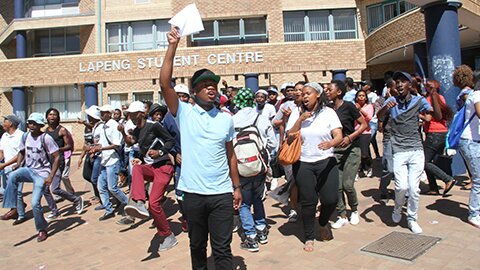
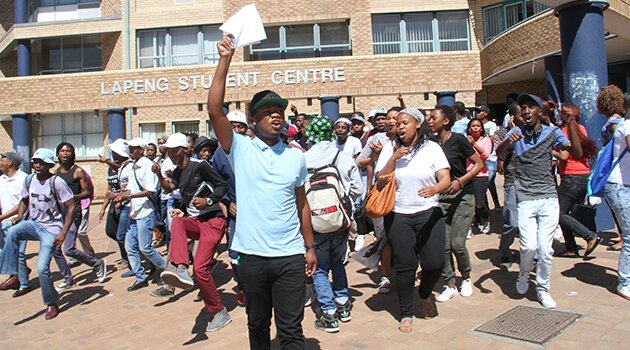
The struggle continues … CUT students moments after agreeing to join protests by university students across the country to demand no-fee education
… Amid hint of disagreement among students over how to prosecute the struggle for no-fee varsity education
Students at the Central University of Technology (CUT) yesterday joined the University of the Free State (UFS) and several other institutions of higher learning across the country when they shut-down the college and declared that it will remain closed until management pronounced its position on the fees for the 2017 academic year.
The students who had not significantly participated in any protests over fees since the beginning of the #feesmustfall movement in September last year declared in marathon back to back meetings held at the Bloemfontein campus that they wanted free quality education.
This stood in stuck contrast to the announcement made by higher education and training minister Blade Nzimande on Monday that universities could increase fees by up to eight percent. He said government would provide substantial support to poor, working and middle class families at universities and Technical and Vocational Education and Training (TVET) colleges
 Nzimande said his department had received an additional 18 percent for the 2016/17 academic period with an average annual increase of 9.8 percent across the Medium Term Expenditure Framework period up until 2018/19.He said from R42 billion in the 2015/16 financial year the department’s budget was set to rise to R55.3 billion in 2018/19.
According to Nzimande, government has this year provided R1.9 billion of the R2.3 billion shortfall resulting from the subsidisation of the 2016 university fee increase. He said more than R4.5 billion in the 2016/17 financial year had been reprioritised to the National Student Financial Aid Scheme (NSFAS).
The minister said expanded funding was targeted to support 205 000 students entering universities for the first time or continuing this year and a further 200 000 students at TVET colleges, meaning total of 405 000 students would receive government support to access universities and colleges in 2016.
The National Skills Fund (NSF) had allocated R1.393 billion in 2016 towards funding undergraduate and postgraduate bursaries in scarce and critical skills. The funding was directed at meeting the full cost of study for over 13 500 undergraduate and 1 200 postgraduate students enrolled in programmes at 26 public universities.
But this, among the proposed set of measures, failed to satisfy the CUT students who declared during an initial meeting led by the Student Representative Council (SRC) president Thapelo Ngozo in the morning that they were shutting down the university until university authorities presented their position.
The students were adamant that they wanted free quality education which did not categorise them as rich and poor.
Ngozo tried in vain to persuade the students to wait until the university council sat and hear their position.
“If we are going to shut down the university, what are we protesting for? The university has not yet pronounced its position on the fees for next. I suggest that we wait for that pronouncement,” said Ngozo but his seemingly voice of reason fell on deaf ears as the students blatant insisted on shutting down the university.
The students then left the meeting and marched to the library and other faculties mobilising other students to mobilise them
Acting Vice Chancellor Professor Henk de Jager then addressed the students just after 2:30pm pleading with the students to be patient and allow the university council time to deliberate the matter, but again his efforts yielded nothing as the students insisted on the university authorities to bring the meetings forward.
The students told the Vice Chancellor that the university would remain closed until the authorities presented their position to them.
De Jager told The Weekly after the meeting that he respected the views of the students but he was concerned that the tests set for today might have to be postponed.
“We are not disappointed by the position taken by the students. We understand the national context of this whole debate. But I think if you look at the statement by the minister, there are some definite advantages for the poor. As an institution, like I said when I addressed the students, academically deserving students should not be financially excluded. That is critical for us and I think the minister’s plan makes provision for that,” said De Jager.
He said they would allow the student fees committee to meet before the finance committee of the university council meets early next week. The full council of the university is expected to meet after that.
“We are there to listen to the students as well and that was the whole purpose of today’s meeting. We wanted to engage with the students and listen to their voice. We will convey their message to the chair of council and he will eventually decide whether it is possible to hold the council meeting or not.
“So, I am really not disappointed with the stance taken by students but I am worried that we are going to disrupt the tests. As soon as you postpone them you need to catch up. They are the ones that will be disadvantaged,” added the concerned Vice Chancellor.
Disagreements between student leaders and fellow students seemed more pronounced at the UFS where the SRC allegedly pulled out of deliberations on the programme of action following the closure of the university on Monday.
At the time of going to print last night, the UFS SRC was said to be locked up in a meeting a with a splinter group calling itself Free Education For All.
The group had literally taken over all planning for student activities since the university closed.
A seemingly frustrated Lindokuhle Ntuli who leads the UFS SRC poured his heart out on his Facebook page after having differences with other students on the plan of action following the fees announcement by minister Nzimande.
“At times we are challenged to make unpopular decisions in order to ensure and protect the safety of our students, even if it means the decision is not to the tune of some. The decision to call off the protest is not motivated by any selfish ambitions or agendas but rather bona fide with a deeper analysis into ‘can we conduct a non-violent protest?’ ‘Can we ensure the safety of our students given the recent events and threats of violence?’
“When a life of a student is threatened with harm, we have no option but to protect that interest and to make that unpopular call. The movement cannot be a threat to fellow students but rather to the government that must deliver on free and quality education,” read part of a post which was later removed.
He posted the statement following a physical altercation with other students during a meeting on Tuesday afternoon.
Young Communist League UFS branch secretary Gatebe Gcinumoze said the students were not asking for the impossible but were just asking government to deliver on its promises. He said students wanted free and quality education for all.
“The fact that there is still a price on tertiary education is a problem,” said Gcinumoze.
“We should at least be able to attain our first degrees for free. These short-term interventions announced by minister Nzimande will not work. There are many students who failed to get funding last year we do not want a repeat of that. We believe the government has got the means to finance tertiary education. They just need to reprioritise the spending. Another way could be to introduce a corporate tax to finance tertiary education,” he added.
ANC Youth League provincial chairperson Makalo Mohale concurred with the students saying his organisation rejected the entire argument that universities be given the latitude to increase fees up to eight percent. He said the minister must respect the decision of the organisation that deployed him to government (ANC) which resolved that there will be no fee increment.
“The suggestion by the minister for universities to decide whether or by how much to increase fees takes away the hope of South African youths that there could ever be free university education,” said Mohale.
On Wednesday, Nzimande expressed concern at the demands of the students and urged parents to join the debate over tertiary education fees and help come up with long lasting solutions.
In a rather hard hitting statement, ANC secretary general Gwede Mantashe said if he was higher education minister, he would close universities for up to 16 months to teach protesting students a lesson.
He said the students were “not doing anybody a favour” but were being unreasonable with some of their demands because tertiary education was expensive and government was trying to make it accessible to a cross-section of students through its interventions.
