Tshiame economic zone takes shape
29 000 new jobs expected once it’s operational
Work to develop the Maluti a Phofung special economic zone (M-SEZ) at Tshiame, in the eastern Free State town of Harrismith, is already underway, with the construction of a 26-km fence around the area designated for the special zone at an advanced stage.
The M-SEZ is a flagship development project for the province that will see the establishment of a logistics hub and agro-processing park at a cost of R1.5-billion, with the Free State Development Corporation (FDC) that is behind the project estimating 29 000 jobs will be created once it is fully operational.
The project that was launched in 2013 by Premier Ace Magashule and German minister of justice and labour Martin Gunthner – whose country has contributed R57-million to the venture – is an ongoing project that will take several years to reach full maturity, according to Osman.
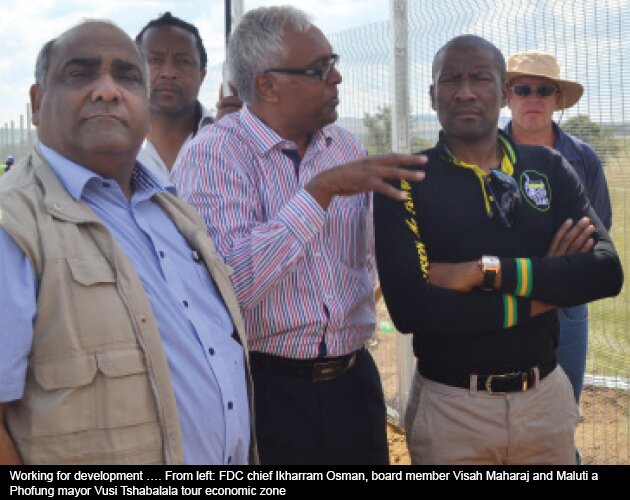
During a media tour of the project on Monday, FDC chief executive officer Ikhraam Osman said the M-SEZ will be a platform to empower local communities through the provision of jobs and opportunities to set up their own businesses in line with government policy to empower previously disadvantaged blacks and to promote small and medium-scale enterprises.
Already 70 jobs have been created for people from the surrounding area hired to help in the construction of the R60-million perimeter fence, said Osman.
He said: “The M-SEZ will boost the local economy and businesses . . . this will be done through ensuring that communities benefit from skills transfer, while also having an opportunity to establish their own businesses.”
According to Osman, a key boost to the local as well as the provincial economy will be the establishment of the Tshiame Food Processing Park in the special economic zone.
The park will see Harrismith – which already houses a huge Nestlé infant nutrition plant — turned into an agro-processing centre hosting several multi-national and domestic companies processing farm produce for the domestic and export markets, he said.
Osman said: “Plans are under way to establish a food processing park which will include a potato crisp manufacturing plant, a cereal manufacturing plant and a fresh produce hub.
“Opportunities also abound in fruit juice processing, deciduous fruit canning as well as for a starch processing plant.
“The hub will host multinational and domestic companies in the food production sector and will provide logistical services, warehousing and cold storage.”
The FDC boss added that there were also plans to use the special economic zone’s favourable terms to attract Chinese pharmaceutical and medical products firms to set up production plants in the area.
A planned logistics hub will see Tshiame turned into a port of entry with container handling facilities, said Osman, adding the development will help attract more business and investment to Harrismith.
He said a vehicle distribution centre is also planned at Tshiame as part of the logistics hub and will serve as centre to distribute vehicles manufactured at plants in Durban, East London and Port Elizabeth to various destinations across the country and beyond.
Osman said: “A container terminal in Harrismith will unlock the country’s import-export logistics by serving as an inland port.”
“There will be a vehicle distribution centre in Tshiame, Harrismith which is part of the Durban/Free State/Gauteng logistics corridor intended to harness the unique advantages of the town’s location,” he added.
Harrismith sits at the centre of one of South Africa’s major interchanges of national and regional roads – the N3 freeway (between Johannesburg and Durban) and the N5 (Durban to Cape Town route).
It offers a unique opportunity to reduce the costs of freight by creating an inland port that can handle cargo containers through off-loading road cargo to rail, thereby reducing the truck congestion on the roads.
It is projected that with the current steady economic growth of the Free State and the country, the percentage of road cargo passing through Harrismith will increase by at least 35 percent annually over the next seven years.
Vusi Tshabalala, the executive mayor of Maluti a Phofung Local Municipality, under which Harrismith falls, said the local authority will play its role to make the M-SEZ a success by making sure it has uninterrupted availability of essentials such as water and electricity, key to attracting investors.
“As a municipality we are the custodian of this project and it is in our interests that it succeeds,” he said.
“We have already addressed obstacles such as electricity and water challenges here.
“We will also make sure that we fill up the potholes (in the roads) in order to impress (potential) investors.
“Besides these we will engage with community members to brief them about the importance of this project and to tell them that they must regard it as theirs and protect it.”
A special economic zone is an area or a district in country set aside for special or targeted economic activities.
It is subject to special economic rules and regulations that are different from those applicable to other parts of the country outside the special zone.
The rules are designed to promote investment and could include such things as a lower company tax rate and tax holidays for new investors.
