
Govt seeks to empower artisans
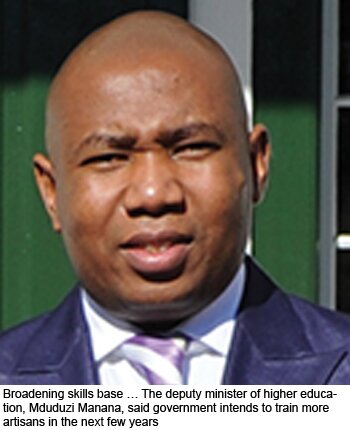 The deputy minister of higher education, Mduduzi Manana, has revealed government’s plans to set up an office specifically dedicated to artisanship in every province by the end of this year, in a bid to intensify efforts to develop artisanship as a career choice.
“The planning for such offices is well underway and we have the money to recruit the people and rent offices from FET colleges. We are more than 100 per cent committed to ensuring that 2013 is a seriously successful year for artisans,” said Manana when he addressed thousands of students from Maluti FET College at Kwetlisong in QwaQwa last week Friday.
Manana revealed that discussions had been going on for some time, about the need to develop qualified and skilled artisans to respond to the escalating scarcity of employment.
According to Manana, a large number of qualified and competent artisans are required for the government’s strategic infrastructure projects such as building of roads, schools, ports, universities and power stations, as announced by President Jacob Zuma at the beginning of the year.
He went on to reemphasise the need to accelerate the process for improving the status and profile of artisanship as an inspirational career pathway for South Africans, in particular the youth who he advised against the assumption that university education is the only key to a bright future.
Manana also advised students already enrolled in FET colleges to work towards becoming entrepreneurs and job creators rather than job seekers.
He, however, highlighted some challenges that artisans meet in their quest to follow the profession.
“The hardest and most difficult part of becoming an artisan is that it completely depends on finding a workplace that is approved by the department of education to take in artisan learners, often called apprentices. Last year, we could not get businesses to participate in the programme.
“Government departments took only 24 378 artisan learners. We need more workplaces to absorb students but that is difficult due to high costs of training an artisan. It costs about R300 000 to train a person to become an artisan. It is time that the skills mismatch is addressed so that, upon completion, everyone is hands-on and is able to produce in the field of their choice. Government is walking the talk; by 2012 it had released 125 occupations.”
At the same occasion, the member of the mayoral committee for public safety, Moeketsi Lebesa, encouraged the youth of Maluti-a- Phofung to use the imminent opportunity to improve their lives.
“South Africa needs young men and women who are skilled. This can only be achieved through manpower development.”
Meanwhile, an FET college graduate who is now a businessman and employer, Mokone Mofokeng, had a word of advice for the students:
“Do not be ashamed of what you do. Being artisan can change one’s life for the better. I am a living example. I did not want to go to Itemoheng FET college initially, as it was not regarded as ‘cool’. But that very same college has nurtured me into an independent man and a millionaire.”

Ms. K Unrestricted


Follow Us onTwitter