
Dumping site Turns into Goldmine
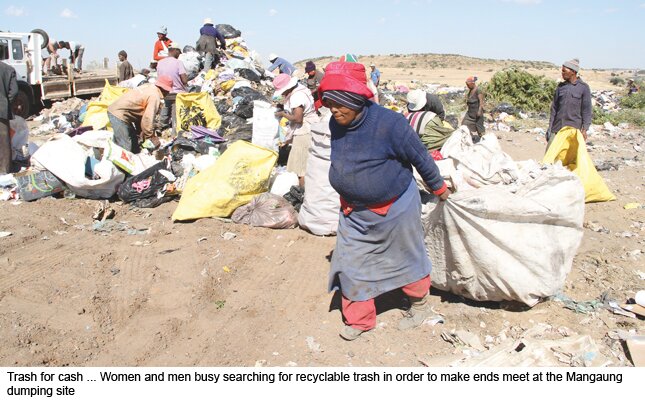
The provincial department of social development has set aside R363 000 for the recycling project run by close to 200 people who used to scavenge for food at the dumping site
For ages, the Mangaung dumping site outside Bloemfontein was the lifeblood of destitute and sometimes homeless residents of Dinaweng, Freedom Square, Motshabi and Mafora Square; who would irk out a living scavenging through the garbage day in day out for something to eat and whatever clothing items they could find.
Apart from the pungent stench of the waste, these people on the periphery of society would in the process be exposed to diseases such as hepatitis A, salmonellosis, and even food poisoning. They were forced into this ordeal by circumstances beyond their control; they could not secure proper jobs for reasons ranging from lack of identification documents, skills and education.
But now, thanks to the department of social development, they have been thrown a lifeline with a R363 000 recycling project – aptly named Kopanang MaAfrika Co-op. Instead of rummaging for something to eat, they now sift through the rubble in search of paper, plastic and glass to recycle and generate income for themselves.
The 170-strong men and women meet at the land fill site every morning from Monday to Friday. They then take off their clean clothes and don dirty overalls designated for the job they do. The women apply yellow clay to their faces – it is their version of sunscreen. Then a long day of work begins.
The secretary of the co-operative, Dikametsi Motlhatlhedi (32), started scavenging the dumping site for clothes and metal pieces in 1997, because it was the only way she could provide for two sons. She would sell the metals at a local scrapyard and would make up to R1 000 on a good day.
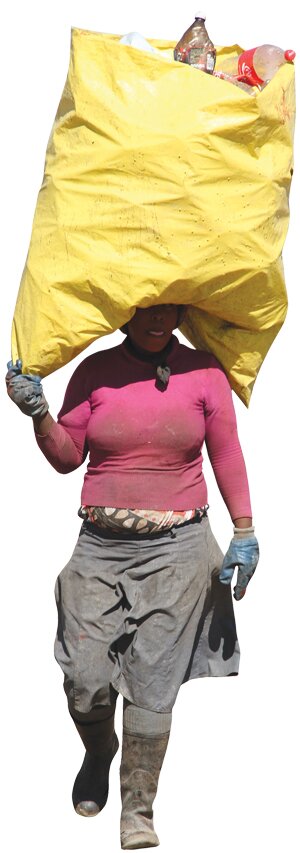
 “There were few of us then. I used to make good money, especially in summer. It was a bit tough in winter when people bought less cold drinks; leading to a scarcity of cans.
“Then one day the MEC for social development, Sisi Ntombela, approached us while we were busy at the dumping site and advised us to unite and form a co-operative, so that the government could meet us halfway.
This, we promptly did in 2008. At the moment we collect and send used paper, plastic and metals to be recycled by a Gauteng company,” added Motlhatlhedi.
Motlhatlhedi said they would like to do the recycling themselves but they are struggling to acquire a site and electrification from the municipality.
A member of the co-op, Aletta Setlhabi (31), revealed to The Weekly that she started working at the dumping site in 2008 when her parents died, leaving her with her two siblings and three kids of her own.
“A woman working at the dumping site called me when she saw the conditions I was living in and showed me how to make money to support my five dependents.
“I make up to R400 a day, and can provide for my high school-going siblings and minor children. We also live in a more decent house,” said Setlhabi.
Another member of the co-op, Esther Moletsane (38), used to work at a doctor’s surgery in Botshabelo as a cleaner, until she was retrenched in 2008. She was advised to go the scavenging route by a neighbour who witnessed struggles.
“I was reluctant at first, but I have no regrets now as I make about R200 a day from collecting waste products and selling them. Thursdays and Fridays are particularly good business days, because that’s when more garbage is delivered,” daid Moletsane
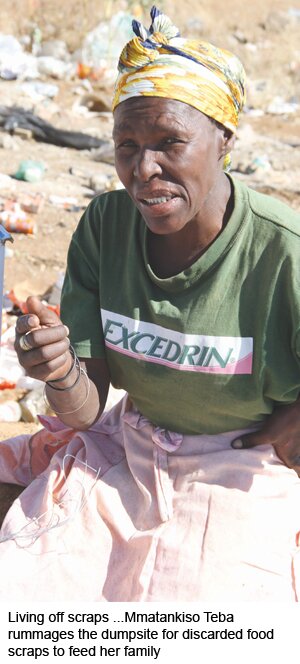
However, not everyone is finding it all rosy at the dumping site, especially those who are not members of the recycling co-operative. Matankiso Teba is one of the many who still scavenge for food for her four children.
The 54-year-old widow said abject living conditions have forced her to go to the dumping site to scramble for any edible scrap item she can lay her hands on, such as discarded bread, vegetables and canned fish.
“I live in a shack with no electricity or running water. All I need is someone to take me in as a domestic worker so I can stop looking for food in dust bins. All my efforts to find a job have been in vain,” lamented a dishevelled and evidently malnourished Teba, who looks 20 years older than her real age.
Social development spokeswoman, Ipeleng Morake, told The Weekly that the department started funding the Kopanang MaAfrika Co-op during the 2011/2012 financial year after the MEC’s visit to the dumping site where she advised the scavengers to formalise their activities into a recognised income-generating venture.
The department has set aside R363 000 to buy recycling equipment for the co-op, but the money has not yet been disbursed because the department is waiting for the municipality to provide a site and electricity connection. During the 2013 budget, Ntombela revealed the department’s plans to uplift and empower people making a living from scavenging.
“In the new financial we are going to implement the project in Welkom. These people will also be profiled with the purpose of linking them to the Food and Clothing Bank and other services of the department and we have set aside a budget of half a million for the establishment of the recycling project,” said Ntombela.

Ms. K Unrestricted


Follow Us onTwitter