
Crime indaba charts way forward
The scourge of crime, which has literally taken over the lives of South Africans, took centre stage as delegates from a wide spectrum of society converged in Bloemfontein last week to craft a roadmap to rid the province of this malady.
The aim of the two-day crime summit, which started on Thursday, was to investigate the causes of various forms of crime, examine its extent and impact on society, and identify possible long term solutions to make the province and the entire country a safe place for all.
The meeting saw participants locked in deliberations on how to combat criminality. In the end, they came up with recommendations to do just that.
The debates revolved around, among others, the role of moral regeneration in strengthening collaboration towards reducing contact crime, youth involvement in crime, police killings and the impact of crime on the economy.
It transpired that challenges associated with contact crime are ineffective laws, lack of respect for the law, poverty, unemployment, disintegration of families and lack of street lights.
For the short term, it was proposed that the liquor laws be amended and that religious leaders spearhead moral regeneration. Easy access of young people to cyber sources of inappropriate content was also blamed for youth involvement in crime, especially drug abuse and gangsterism, hence the need for government to regulate cell phone content.
The participants proposed that government assist in establishment of clubs where the youth can meet and fight gangsterism. School drop-outs should also be accommodated through self-esteem building forums so that they don’t engage in crime.
The impact of crime on the economy also came under the spotlight, with the conference recommending South Africa forge closer links with Lesotho to build strong socio-economy ties. Marketing structures for tourism, investments and sport should also be intensified.
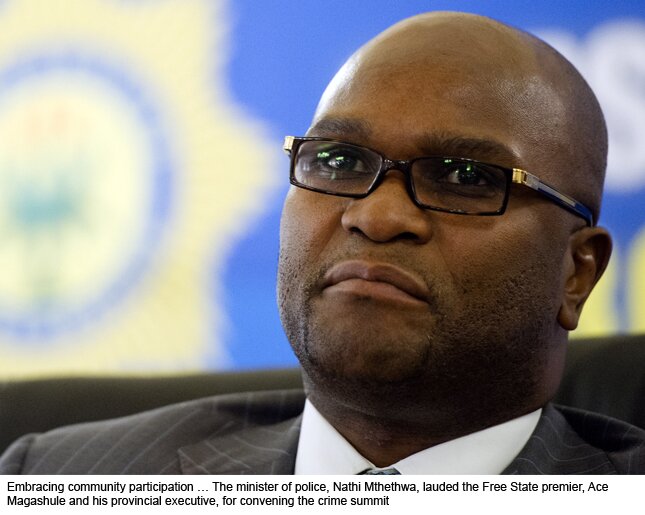
At the summit, the minister of police, Nathi Mthethwa, lauded the Free State premier, Ace Magashule and his provincial executive for convening the crime summit that sought to find innovative ideas in the fight against crime.
Mthethwa said summits like that provide an opportunity to reflect on the social malady that is crime. He described crime as a scourge that respects nobody, adding that it is also a community challenge that requires a societal response as it negatively affects South Africans irrespective of gender, race and religion.
“Community programmes of this manner also help us to tap into the collective wisdom of all the people of our land to enhance existing crime-prevention programmes and seek innovative and creative solutions to challenges of crime and safety,” added Mthethwa.
Mthethwa said the department introduced a new Public Order Policing Policy in 2011 which regulates, among other things, the police of handling public protests. Mthethwa said the country is faced with a serious challenge violent crime.
“Through the intervention and analysis, we can begin to tap into this societal trend of seemingly, resolving challenges through violence. Our view has always been that the battle against crime cannot be separated from the war on desire.
“We believe that the majority of those involved in crime are propelled by greed and extreme sense of selfishness. As researchers, this is one area we believe you can expand on, by providing analysis and empirical evidence to dispute misconceptions that only poor people commit crime,” said Mthethwa.
 Mthethwa said the police derive their mandate from the national constitution, which contains a whole chapter dedicated to human rights. He said the chapter outlines the rights and responsibilities of citizens which every institution of the democratic state is expected to enforce the Constitution.
“Police must see themselves as the enforcers of the law and not the law itself. In this regard, our approach must speak to a number of fundamental areas which we wish to outline to this summit”.
He said his ministry is finalising a white paper on policing which seeks to create a professional police service. He said the department will embark on a national road show to educate station commanders about the contents of the white paper.
“Last year we started work on a policy which is aimed at clarifying the role of the police when carrying out their duties. The policy will speak to all aspects required including supervision, training, and even equipment required in carrying out community orientated policing and minimum use of force requirements.”
Mthethwa said he will personally engage local police stations commanders to understand the new philosopy of policing that is being pursued by government. Mthethwa told people who gathered at the summit that the department’s recruitment processes have improved and has been bench-marked against those of leading police departments worldwide.
He called for a greater cooperation between police and communities in the fight against crime and the increased community participation in the recruitment of people to the South African Police Service.
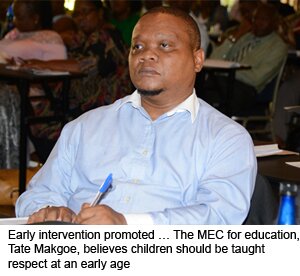
For his part, the MEC for education, Tate Makgoe said male children are always left out from programmes that take place in society. He said the boy child should be taught at a tender age to respect women and the rights of others.
“Something should be done to help the boy child. We should develop programmes meant for those left out children so that they also don’t feel left out of the community.”
The MEC for agriculture, Mamiki Qabathe, said the department has to enhance transportation in rural areas. She noted that farm workers lose cases in court as they do not attend court cases, not because they do not have means of transportation nor that they don’t have strong cases.

Ms. K Unrestricted


Follow Us onTwitter