
Women’s Poultry co-op blossoming
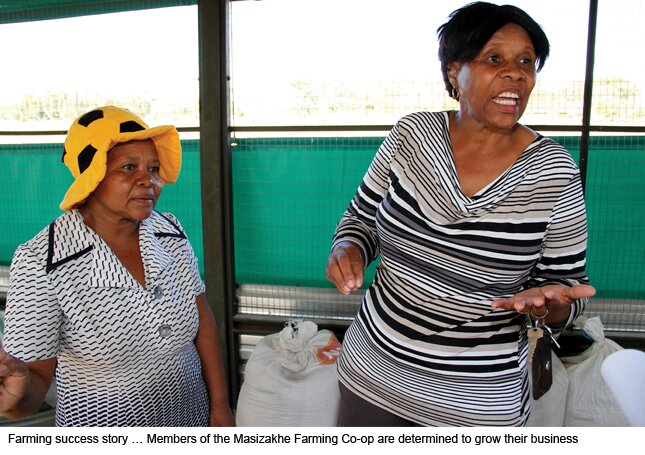
The department has promised to supply each member of the co-op with 3 000 chickens in six instalments and vaccinations as well as chicken
Fifteen residents of Bloemspruit, who have pooled their resources to form a poultry co-operative, are determined to position themselves as credible players in the economy, and shed the tag of community-based co-operatives being unsustainable undertakings.
The members, 13 women and two men, are all farmers who have been brought together by their common passion to make a living from poultry husbandry.
This was revealed to The Weekly by the co-op’s chairperson, Khauhelo Lebentlele who is also an award winning farmer. Lebentlele said the co-op; Masizakhe Farming Co-op was formed by a group of farmers from Bloemspruit area in Motheo region.
“When the co-op started out, we were just a group of women who were making extra cash for our families by investing in a grocery and a burial society,” recounted Lebetlele.
Lebentlele recalled how, one day in 2009 as they were holding a monthly meeting, the members unanimously decided together to venture into other projects through utilising their otherwise unused pieces of land. Poultry production was the popular choice.
The eight founding members then went on to recruit more members who included two men, the other one disabled, before approaching the department of agriculture for technical assistance and support.
The department bought into the group’s vision and proposal, and promptly enrolled all of them on co-operative management and poultry production training. The move was designed to guarantee the co-operative’s survival and sustainability.
“We learnt that chickens need a good strong coop which should be locked up at night to protect them from the elements, predators and thieves. The department then went on to build each member a chicken enclosure, except for the one who does not have her own land.
Lebentlele said they also learnt that chicks must be kept dry and warm, and that it is vital that chicks bond with their mothers (hens) and learn how to scavenge for food.
“We learnt that during the day the chicks should be given small amounts of finely crushed grain, bread, cooked or raw mealie-meal. Clean, fresh water should also be provided in a suitable container that is not big enough for chicks to fall inside. The chicks should not be allowed to get wet.”
The secretary of the co-op, Mpeile Phalo, used to work as a banker in Lesotho until she was retrenched in 2003, when she decided to come back to South Africa. She then decided to follow in the footsteps of her mother who raised her with money she made from her poultry business.
“I bought two cows and 100 chickens to start my own income-generating venture. I was confidence in my prospects of sustainability. The health of my chickens proved to be quite a challenge.
“I approached neighbouring farmers for advice and we just clicked. We discovered that we had a profound common passion for poultry and, as they say, the rest is history,” enthused Phalo.
Both Phalo and Lebentlele appreciate the intervention of the agriculture department, which built each member a state-of-the-art a chicken hutch fully equipped with proper ventilation and lighting. These come in handy for the chickens, especially in winter.
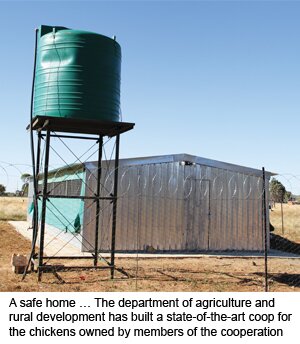 The women are particularly chaffed with the design of the coops, which they describe as easy to maintain.
They disclosed that the department has promised to supply each member of the co-op with 3 000 chickens in six instalments to establish grow their business. They will also be getting vaccinations and chicken feed from the department.
The pair revealed that the short term goal of the co-op is to open an abattoir and supply the entire Free State with meat.
On March 26, the MEC for agriculture and rural development, Mamiki Qabathe pledged her department’s continued support to this and other similar co-ops in the new financial year. She made this promise when she tabled the department’s budget vote at Hennenman.
Guidelines on starting a poulty business
For people who want to go into the poultry business, here are some tips from South African Poultry Association.
The first three to four weeks of life in chicken are very important and the chicks need a lot of protection from predators and the weather.
They should be put into an enclosed pen to protect them and the pen must be moveable and large enough for the chicks to scavenge with their mother and also be moved to fresh ground each day and make sure that there is some extra kitchen waste for them.
Chicks can leave their moveable pen to scavenge more widely for their food with their mother and they still need some additional feed separately from the rest of the flock and from their mother if they are to grow well and keep healthy.
By about four weeks of age you will be able to separate the males from the females by looking at them. Males will grow faster and they should be given extra feed to allow them to do this.
Cocks need to be sold or eaten before they grow fully to save feed and have more space for new chickens to replace them. Chickens start to lay eggs when they are six to eight months old.
Hens in lay have a large red shiny comb and a hen not in lay will have a shriveled, pale comb. Hens normally go in and out of lay so their combs will change colour from time to time.
The owner should always collect all eggs from the nest boxes at least once each day and eggs should not store eggs in a warm place. Eggs should not be kept for more than five to seven days before selling or eating them as the eggs will go stale and many will not hatch out when put under the broody hen.
Select clean, large eggs with good shells for putting under a broody hen. Eggs with thin or cracked shells will not hatch. A large egg will produce a big chick which will be healthy and has a good chance of growing into an adult bird.
When hens are about two to three years old they will either stop laying eggs or lay only a few eggs. They are eating your valuable feed and returning nothing to you. You must eat or sell them and replace them with young hens that are coming into lay.
Cleanliness is the key to healthy chickens, only healthy birds will lay many eggs and grow well. To keep birds healthy, you must provide them with clean water feed troughs and clean coop and inspection should be made every day.
Sick chickens should be removed from the rest of the flock and housed separately and given fresh water and extra food. If they are small they should be kept warm and dry and if they do not recover in four to five days they must be killed and buried away not eaten as it may cause illness.
A young sick bird doesn’t eat, it will have puffed up feathers and may have wet and bloody droppings. Old, sick birds may have dirty feathers around the backside.
There may be sores on the comb and wattles. Some birds may not be able to walk well. Weak legs and curled toes may be the problem. If they cannot walk well you should kill them, as they will eventually die anyway.
Newcastle Disease can suddenly kill off all chicken so it is very important to vaccinate against the disease before they get sick. You will need to get information from the local poultry advisory officer about vaccinating the chicken to avoid losing the entire flock.
In the case of several sick birds, you should seek advice immediately from someone who is an expert on poultry diseases and they may have to try special medicine for chickens.

Ms. K Unrestricted


Follow Us onTwitter