
Calls for expansion of FIXED DOSE HIV drug rollout
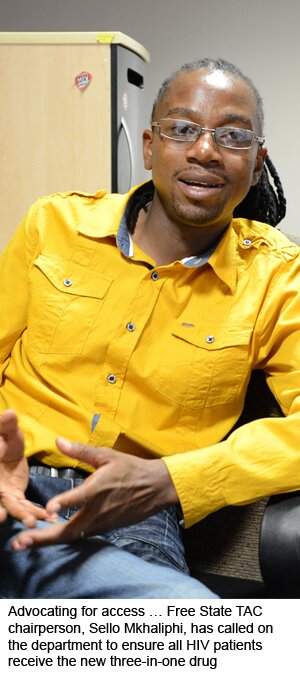 The fixed dose drug costs R89 less than the current three tablets taken three times a day which costs patients up to R400 a month
The Treatment Action Campaign (TAC) in the Free State has welcomed the introduction of fixed dose combination (FDC) drugs for HIV positive pregnant women, but is opposed to its administration criteria that exclude other patients.
The three-in-one drug will be introduced from April 2013 to make treatment easier for HIV positive patients. These drugs will be available only to pregnant women as per new treatment guidelines.
The new drug costs R89 less than the current three tablets taken three times a day. They cost patients up to R400 a month.
The TAC provincial chairperson, Sello Mkhaliphi, said the introduction of the new drug is a great achievement in the fight against HIV and AIDS. He explained that the new drug will reduce cases of patients who default on taking treatment because they do not stick to a strict treatment regime.
“With the fixed dose we believe you have 31 pills that you will take in 31 days rather than 31 pills multiply by three. This is one of the reasons people default on their treatment because they have lost interest in taking pills for years and become tired of the process. They then want to give up or take a break from them.”
Everyone except pregnant mothers will have to wait before receiving the new drug. And this, according to Mkhaliphi, is not what they campaigned for. He said the TAC advocated for the introduction of the fixed combination drug with the expectation that all HIV patients, who are on antiretroviral (ARV) treatment, were going to benefit.
“We understand issues such as the contract that the department has in terms of suppliers and their challenges. The main objective of putting people on treatment is to save lives; we think it’s important that we reconsider the issue we have with patent laws in South Africa.”
However, Mkhaliphi applauded the provincial department of health for enrolling more people on the treatment. He noted that, as an organisation, they have moved away from protesting for availability of drugs. HIV drugs are now readily available and there are no waiting lists at clinics.
“The department has managed to double the number of people who were supposed to be initiated on treatment and eliminated many from waiting lists.But there are cases in a few clinics where we have experienced shortages of nervarapine syrup for babies. This is dangerous for children because they need syrup to prevent mother-to-child HIV infection.”
He hopes that the challenge of ineffective distribution of drugs will not spoil the good work done by the department to provide medication.
“In cases where there were reports of non-availability of drugs, we have found that it was because of the distribution challenges. We discovered that medication was available but it was not delivered to the right health facility or the facility itself did not know of the availability of the medication.”
He encouraged people to utilise public health care facilities, but avoid abusing the system. He gave assurance to HIV positive people that the fixed dose combination drug will also be available to them in the near future because the TAC will continue to fight for its availability to all HIV positive people.
“Let us also stand up and come up with a fixed dose combination drug for all campaign and not for pregnant women only,” concluded Mkhaliphi.
The introduction of the FDC drug country wide was announced by the health minister, Aaron Motsoaledi, on the eve of World Aids Day last year. FDC is the combination of tenofovir, emtricitabine and efa virenz drugs. This drug was approved as it has shown to have major benefit for patient in terms of compliance.
Motsoaledi said the introduction of the drug also means that logistics and storage will be reduced and it has fewer side effects. He added that the FDC brings with it an additional extraordinary benefit for pregnant HIV positive women.
“Because of this new fixed dose combination from April 2013 all pregnant women will be given the fixed dose combination during pregnancy and breast feeding and thereafter if their CD4 count is less than 350. The fixed dose combination is more effective than dual therapy and has fewer side effects for the pregnant mother, in addition to its’ convenient dosage regimen.”
The minister said introduction of the drug will also add a further reduction in the price of ARVs for South Africa, the world’s biggest consumer of the drugs, with 21 percent of all ARVs administered in the country.
In the 2010 tender issued for ARVs, government was able to reduce the expenditure on ARVs by 53 percent. This was followed by the 18 percent saving on TB drugs.
The new tender is valued at R5.9-billion over two years. The state sector currently treats 1.7 million patients with a goal to expand this to 2.5 million by the end of 2014. This new tender was initially expected to cost R8.1-billion based on prices of the current tender, however the health department was able to reduce the cost of the tender by 38 percent, which is a saving of R2.2-billion.
“This saving means we can treat more patients with the same budget,” said Motsoaledi.
The health department awarded the tender for the FDC to three companies Aspen Pharmcare, Cipla Medpro and Mylan pharmaceuticals.
Motsoaledi said they split the quantities so that there is no interruption of supply if one supplier experiences problems.
Approximately 70 percent of the volume of the entire contract was awarded to local manufacturers
Professor Andrew Boulle of the University of Cape Town (UCT), who has been calling for FDCs for a number of years, is excited about the new developments.
“This is fantastic news and the health department should be commended for the stewardship they have shown with this tender.”
Boulle expressed the hope that the department will follow this up by ensuring that these FDCs are packaged in monthly adherence-promoting blister packs to help patients keep track of their medication.
Médecins Sans Frontières/Doctors without Borders (MSF) also welcomed the inclusion of FDCs.
“The inclusion of FDCs is good news for the 1.7 million people currently on ARVs in South Africa, because they now finally have access to simpler and improved treatment options – which significantly cuts down their daily pill burden from 3 to 5 pills down to just one,” said Dr Gilles Van Cutsem, MSF’s medical coordinator in South Africa and Lesotho.
Rolling out drugs in FDC formulations will have significantly positive implications in helping patients adhere to their lifelong treatment.”
FDC formulations do not only benefit patients but also relieve the burden on the South African health system by simplifying the ordering and monitoring of ARV stocks. With fewer pills to pack, transport and dispense cost reductions are also possible.
 HIV/AIDS FACTS
Since it first made its appearance in the early 1980s, HIV/AIDS has killed more than 28 million people worldwide, with more than 34 million people currently living with the virus infection.
In 2011, Statistics South Africa estimated that around 5.4 million people in the country were infected with the HI virus.
There are two types of HIV: HIV-1 and HIV-2. Both types are transmitted by sexual contact, through blood, and from mother to child, and they appear to cause clinically indistinguishable AIDS. However, it seems that HIV-2 is less easily transmitted, and the period between initial infection and illness is longer in the case of HIV-2.
Worldwide, the predominant virus is HIV-1, and generally when people refer to HIV without specifying the type of virus they will be referring to HIV-1. The relatively uncommon HIV-2 type is concentrated in West Africa and is rarely found elsewhere.
The strains of HIV-1 can be classified into four groups: the “major” group M, the “outlier” group O and two new groups, N and P. These four groups may represent four separate introductions of simian immunodeficiency virus into humans.

Ms. K Unrestricted


Follow Us onTwitter