
A LOOMING HEALTH AND ENVIRONMENTAL DISASTER
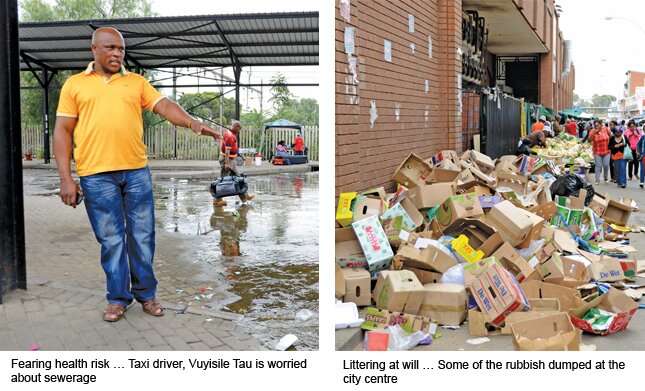
The dumping of rubbish, continuous sewerage spillage and overcrowding of the Bloemfontein city centre has raised serious environmental and health concerns
Imagine the stench of urine, the pungent odour of leaking sewage, the putrid pong from piles of rubbish in every corner and strewn all over the place jostling for space with a panorama of used condoms.
Add to this, vagrants lazing away under the bridge oblivious to the flurry of activity above, the cacophony of loud music from low quality speakers and motorists blaring their hooters impatiently; chesa nyama kiosks and vegetable vendors going about their business on the sidewalk, pedestrians tip-toeing their way around all the filth.
When you have all this in one place, then you know you are in a part of Bloemfontein commonly referred to as ‘downtown’, ‘city centre’, ‘taxi rank area’ or ‘Central Park area’.
Described by many as a ticking time bomb or a disaster waiting to happen, one thing is for sure, this part of town is sick and it is a health hazard. This is the candid fact.
In the meantime, everyone is blaming everyone else for the age-old smut. Some impugn the government for allowing foreign business people to conduct their trade everywhere, while others blame lax municipality by-laws that do not regulate vendors and peddlers.
There are many diseases that can be caused by an environment characterised by such insanitary and squalid conditions. Below is a list of some of them:
Hepatitis A – a food or waterborne diseases acquired through eating or drinking. It is a viral disease that interferes with the functioning of the liver. It spreads through consumption of food or water contaminated with faeces.
Victims exhibit fever, jaundice, and diarrhoea and 15 percent of victims experience prolonged symptoms over six to nine months, but a vaccine is available
Hepatitis E – a waterborne viral disease that interferes with the functioning of the liver, most commonly spread through faecal contamination of drinking water.
The victims experience jaundice, fatigue, abdominal pain, and dark coloured urine.
Typhoid fever – a bacterial disease spread through contact with food or water contaminated by faecal matter or sewage and victims sustain high fevers, if left untreated mortality rates can reach by 20 percent.
Plague – bacterial disease transmitted by fleas normally associated with rats; person-to-person airborne transmission also possible; recent plague epidemics occurred in areas of Asia, Africa, and South America associated with rural areas or small towns and villages.
It manifests as fever, headache, and painfully swollen lymph nodes (bubonic form); the disease progresses rapidly and without antibiotic treatment leads to pneumonic form with a death rate in excess of 50 percent.
Leptospirosis – a bacterial disease that affects animals and humans; infection occurs through contact with water, food, or soil contaminated by animal urine. Symptoms include high fever, severe headache, vomiting, jaundice, and diarrhoea. Untreated, the disease can result in kidney damage, liver failure, meningitis, or respiratory distress.
Fatality rates are low but left untreated recovery can take months.
What the authorities say
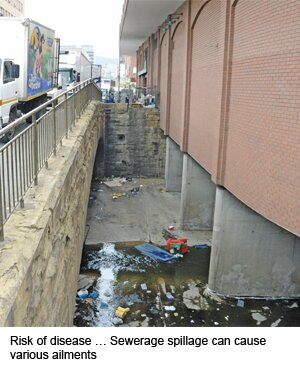 The Mangaung Metro Municipality spokesperson, Qondile Khedama, said there is an increasing number of hawkers as a result of unemployment, and that could be one of the reasons that the volume of waste is increasing in the city centre. This situation makes it difficult for the SMMEs contracted by the city to do their work.
“Some of these hawkers sleep next to the goods that they sell, which, again poses a health hazard. As the city, we are from time to time enforcing our by-laws on street hawking, through our operations with SAPS,” said Khedama.
Khedama said the municipality has contracted SMMEs to clean the city centre as part of the city’s economic strategy to empower small entrepreneurs.
“The reality of the situation is that the city has been inundated by calls from members of the public, complaining about the performance of some of these SMMEs.”
“The municipality is giving attention to the problem and it will soon introduce an approach that is aimed at ensuring the city’s cleanliness, but the municipality is reviewing the environmental policy and the by-laws,” said Khedama.
The municipality will penalise the SMMEs that do not do their work according to the conditions of their contracts. The city is monitoring the performance of all contracted SMMEs. In cases where SMMEs are not performing in accordance with what is stipulated in their contract, we will impose a penalty.
According to the department of economic development, tourism and environmental affairs’ head of communications, Kgotso Tau, a clean town attracts tourists and investors.
He said everyone is entitled to a clean environment, and the municipality together with environmental officials have a mandate to enforce that.
“East Berger Street leads to many tourist destinations in Bloemfontein and it would be ideal to keep the entire area in its vicinity clean at all times.”
Traders complain about loss of business
Vuyisile Tau, a taxi driver for Bultfontein taxis said sewage has been seeping unbridled at the Bloemfontein long distance taxi rank for more than four months.
“In the past month I have witnessed no less than six people tripping on the slippery surface and falling. One was a woman with a baby on her back, and another one was a blind man with a walking stick.”
“Taxi drivers have their meals in these malodorous conditions while waiting for their vehicles to fill up. I always fear for my health because of the reeking water.”
One of the vendors, Selloane Nkalitshane has been selling fruits at the taxi rank for more than five years and used to make good money. Business is not good anymore because customers think her wares are as unclean as her surroundings.
“Speeding cars splash the smudgy water al over us and when we get home we smell of the sewage. Sometimes I don’t blame people for not buying my goods. Who would want to buy fruits they saw showered by sewage water,” said Nkalitshane.
What the experts say
A local environmentalist, speaking on condition of anonymity, did not mince his words as he as he openly blamed the smudge in the city on foreigners.
“The problem started when foreigners began to trade laissez faire in the city. Now the foreigners are giving out the bundu doctors and diamond exchange pamphlets on every part of the streets. The locals, after reading the flyers and deciding they are not interested in the advertised services, just toss them away, thus contributing to littering.”
He added that when the foreigners arrive in the city with no place to stay, they cram into a single room.
“Sometimes up to 20 of these squatters use one toilet, which leads to blockages. The sewage that comes from blocked drains treks down to the rivers, which are the city’s source of water. Due to unskilled workers, the water comes back not unpurified and the people who consume the contaminated water contract diseases,” added the concerned environmentalist.
He said pollution would continue unabated until the government or the municipality come up with a plan to regulate foreigners and hawkers.
However, he called on the municipality to stop out-sourcing services like waste management, and do the task itself.
A local environmentalist, speaking on condition of anonymity, did not mince his words as he as he openly blamed the smudge in the city on foreigners.
“The problem started when foreigners began to trade laissez faire in the city. Now the foreigners are giving out the bundu doctors and diamond exchange pamphlets on every part of the streets. The locals, after reading the flyers and deciding they are not interested in the advertised services, just toss them away, thus contributing to littering.”
He added that when the foreigners arrive in the city with no place to stay, they cram into a single room.
“Sometimes up to 20 of these squatters use one toilet, which leads to blockages. The sewage that comes from blocked drains treks down to the rivers, which are the city’s source of water.
Due to unskilled workers, the water comes back not unpurified and the people who consume the contaminated water contract diseases,” added the concerned environmentalist.
He said pollution would continue unabated until the government or the municipality come up with a plan to regulate foreigners and hawkers.
However, he called on the municipality to stop out-sourcing services like waste management, and do the task itself.

Ms. K Unrestricted


Follow Us onTwitter