
Government confronts natural disasters
The province experiences disasters such as floods, drought, snow, and veld fires, accidents, oil spillages and seismic eruptions which are common around Lejweleputswa and Thabo Mofutsanyana District Municipalities
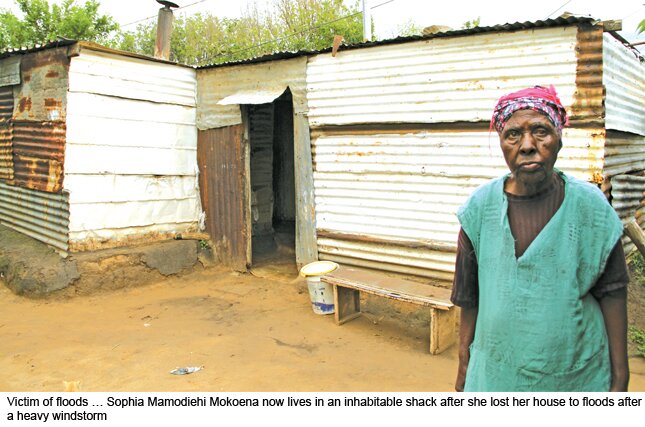
Sophia Mamodiehi Mokoena (87) of Kestell lives in a tiny shack with her three grandchildren because she cannot afford alternative lodging. She is one of the scores of people who were dealt a nasty blow by a windstorm that ravaged the small town last month, leaving in its wake a trail of obliterated and flattened houses.
Mokoena believes if her deceased husband, who passed on in 1982, were still alive (he died in 1982), she would not be living in this misery. She had three children but two of them since passed on. She is now left with one daughter and three grandchildren.
In 1986, the municipality evacuated her from her brick house because it was built on a perennially waterlogged and swampy piece of land, which rendered it uninhabitable.
Eventually, it turned out she had jumped from the frying pan into the fire as the topography of the new place is just as bad. The two-room shack she now lives in is erected on a flat stretch of land and is continually flooded on rainy days.
“Please help me. This is no place for a human being to live in. As you can see, I am too old and I cannot see properly, it’s a struggle for me to try and prevent water from flowing into my shack. You are my last hope,” pleaded Mokoena with the human settlement officials who had paid her a visit.
Her plight was echoed by her grandson, Patiso Ganya, who declared the problem a nightmare.
“The endless clamminess in the shack has destroyed our furniture. We would appreciate a house from our government as a matter of urgency.
“The shack is also infested with rats. It is very sad; I don’t know how to describe our situation, except to say the shack is not at all comfortable,” said Ganya.
The department of cooperative governance, traditional affairs and human settlement (Cogta) promised to look into her plight and possibly address it.
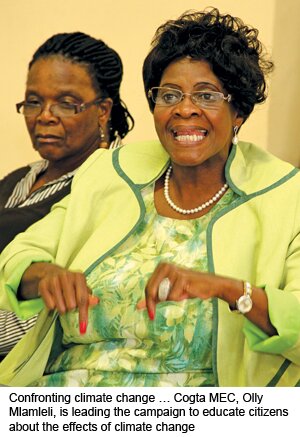
This visit to Mokoena’ house came after the Cogta MEC, Olly Mlamleli, was briefed about Mokoena’s problem. She then sent officials from her department to assess the situation and report back to her.
The Free State is prone to different natural disasters that sometimes claim people’s lives and damage their homes. The common ones are heavy rains, drought and veld fires. Raising awareness to communities can help in reducing the impact.
This province experiences rainfall during summer with heavy frost over most areas in the province. It is mostly during this season that the province experiences disasters such as floods, drought, snow, and veld fires, accidents, oil spillages and seismic eruptions which are common around the Lejweleputswa District Municipality.
Destructive storms appear to be becoming a trend in the Free State. In December, less than four weeks before the Kestell disaster, Kroonstad was hit by a strong storm that left one person injured and homes damaged. At about the same time, strong winds and heavy rains ruined more than 300 homes in Harrismith.
The same weather pattern was experienced in Bethlehem, Deneysville, Oranjeville and Reitz. In the beginning of 2013, one person was killed and 105 others were injured in a heavy storm in Sasolburg. Thousands of houses were also affected. Injuries in this area ranged from minor to serious ones.
 The Free State provincial disaster risk assessment (DRA) has identified a wide range of risks which pose a potential threat to province.
However, it is not practical nor it is financially achievable to address all the risks simultaneously. However, Cogta will, in the meantime, raise awareness on climate change as a root cause of bad weather patterns.
According to the department, effective and focused disaster risk management planning by all stakeholders, districts and other municipal entities can only be achieved through the identification of priority disaster risks.
“It is therefore necessary to adopt a carefully considered process which will enable this prioritisation,” said the department.
However, disaster risk management planning is not a stop or start activity. It needs to continue and produce dynamic and real time plans which will remain current in a continuously changing environment. This must work hand in gloves with disaster risk reduction plans.
“The disaster management plan of the Free State province must focus on the development of plans and the implementation of explicit programmes, projects and practices. This will give priority to building resilience and reducing the impact of a wide range of different disaster risks in areas, communities and households known to be prone to risk in its area of jurisdiction,” the department emphasised.
The disaster risk reduction planning consists of vulnerability reduction planning and specific risk reduction projects. The vulnerability reduction planning focuses on the general vulnerabilities that are present in the province.
The specific risk reduction projects include on one hand future developments that should be assessed and any area where a combination of vulnerabilities, hazards and a lack of capacities pose a specific high risk to the population, infrastructure and environment.
“The department is currently preparing to go on a campaign to create awareness on climate change, as a root course of the current experience of heavy windstorms, tornadoes and floods as well as droughts in some of the Free State and major disaster sin the rest of the world. This campaign will be conducted together with municipalities,” said the department’s spokesperson, Senne Bogatsu.
According to Bogatsu, the campaign will inform communities about steps to be taken to minimise the impact of the disasters. The emphasis will be on construction of houses of good quality to ensure that the impact is minimised.
“At the core of this campaign is for us to persuade our people to join the world in ensuring the reversal of the effects of climate change through disaster risk reduction behaviour.”
In 2011, the department held a disaster risk reduction conference that enforced the need for community awareness and provision of needed information to citizens of this province. It also encouraged municipalities to plan and work towards reducing risks in the quest to minimise the impact of disasters.
This plan, if implemented effectively, will reduce cases where people lose their homes due to heavy rains and floods. Areas most affected by the disasters in 2012 and 2013 are the Lejweleputswa District Municipality and the Thabo Mofutsanyana District Municipality.
The department is still at work building houses that were destroyed during heavy rains in Kestell last year. The destroyed homes were more than 60 and a commitment was made to rebuild them.
The extreme or severe thunderstorm is a main feature in South Africa. Even if it is not severe, the lightening can have a serious implication.
Rains, heavy or light one can also cause floods. This happens when the earth’s surface has absorbed enough water and cannot absorb any more water. This means the moisture is too much in the ground to extend where it result in run-offs which ultimately turn into floods.
The other weather condition that can cause problems is a thunderstorm. This weather condition is accompanied by hailstorms that can also be serious depending on how big they are. A thunderstorm is also accompanied by strong winds that damaging to weak buildings.
A tornado is said to be inside the thunderstorm. It is caused when a cloud is pushed by a strong wind.
The challenge here is that the direction of the air differs; it comes from up and down but going one direction. These severe thunderstorms are found in the Free State but sometimes they do not have a severe impact on buildings because they happen in open space
These weather patterns can also be associated to climate change because it was estimated some 50 years ago that due to climate change, severe weather conditions will be experienced.

Ms. K Unrestricted


Follow Us onTwitter