
ZUMA ENDORSES NDP AS SA’S PLAN
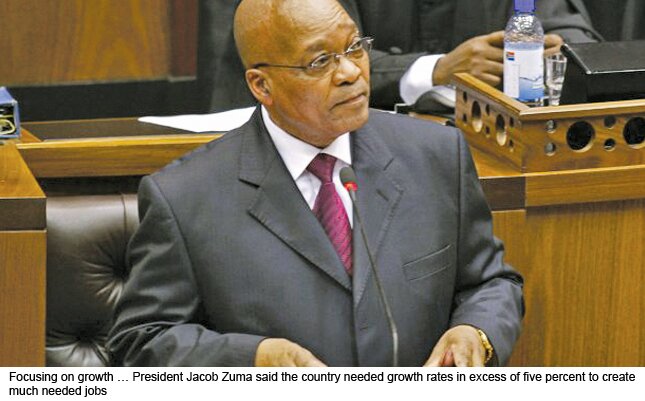
The NDP wants to ensure that the South Africans have water, electricity, sanitation, jobs, housing, public transport, adequate nutrition and quality healthcare
Emboldened by his victory at the ANC national elective conference in Mangaung last year and 14 months before the next year’s national elections, President Jacob Zuma delivered his most plausible State of the Nation Addresses yet last week Thursday, outlining the achievements, shortcomings and challenges of his government elected in 2009.
In his address, Zuma announced that his government’s programme of action for 2013 would revolve solely around the proposals contained in the National Development Plan (NDP) and aimed at tackling the triple challenges of poverty, unemployment and inequality.
The National Planning Commission handed over the NDP to the President last year in Parliament and it comprehensively encapsulates the vision of the country for the next 20 years.
“It is a roadmap to a South Africa where all will have water, electricity, sanitation, jobs, housing, public transport, adequate nutrition, education, social protection, quality healthcare, recreation and a clean environment,” Zuma told the sitting.
According to Zuma, the achievements of these goals had proven to be difficult in the recent past, due to the global economic recession.
“The crisis in Eurozone affects our economy as the Eurozone is our major trading partner accounting for around 21 percent of our exports,” he said.
He indicated that SA’s growth rate was expected to average at 2.5 percent this year, down from 3.1 percent in the previous year. Zuma further stated that the country needed growth rates in excess of five percent to create more jobs.
The president asserted that government had declared education as the apex priority in 2009 and intimated that it was pondering to designate the sector as an “essential service for our nation”.
However, he qualified the assertion by cogently stating: “by saying education is an essential service we are not taking away the Constitutional rights of teachers as workers to strike.”
Zuma also announced the creation of a Presidential Commission which will investigate the appropriateness of the remuneration and conditions of service by the State to all its employees.
“All successful societies have one thing in common – they invested in education. Decent salaries and conditions will play an important role in attracting, motivating and retaining skilled teachers,” emphasised Zuma.
He said he had directed that the first priority should be teachers.
“In elevating education to its rightful place, we want to see an improvement in the quality of learning and teaching and the management of schools. We want to see an improvement in attitudes, posture and outcomes.”
Zuma also welcomed last year’s matric results which showed that grade 12 pass rate was finally on an upward trend and he congratulated parents, teachers and communities for the continued improvement.
He also commended the improvement each year in the Annual National Assessment (ANA) results but said more was work was required to improve the learning areas of maths, science and technology.
The ANA tools used in the schools have become a powerful instrument of assessing the health of education system in the country. The president further announced that the department of basic education would establish a national task team to strengthen the implementation of the mathematics, science and technology strategy
On the sensitive and emotive matter of land reform and rural development Zuma revealed that the concept of ‘willing buyer, willing seller’ – which forced the state to pay more for land than the actual price – would be replaced by the ‘just and equitable’ principle for compensation which would shorten the time to finalise a claim and provided for in the country’s constitution.
He indicated that there were proposed amendments to the Restitution of Land Rights Act, 1994 to provide for the re-opening of restitution claims, by people who missed the deadline of December 31 1993. He said also to be explored ,would be exceptions to the June 1913 cut-off date to accommodate claims by the descendants of the Khoi and San as well as heritage sites and historic landmarks.
From 1994 the government has been hard at work in its efforts to address the complex land question in South Africa through its restitution, redistribution and tenure programmes.
All the same, the government in its own medium-term review last year revealed a number of shortcomings in its land reform implementation programme. As a result, Zuma told Parliament that the State would not be able to meet its redistribution targets but would use lessons in the report to improve implementation.
He said a key lesson derived from the report was a need to provide adequate post settlement support to new landowners so that land continues to be productive.
“When we do the redistribution we need to be mindful of food security. Training and mentorship of emerging black commercial farmers must take place,” Zuma pointed out.
South Africa is commemorating this year the centenary of the 1913 Natives Land Act which was introduced to dispossess the African majority of their land and expectations are soaring in the country for the government to speedily resolve the issue.
To tackle the massive crisis of youth unemployment in the country, Zuma announced that the employment youth incentives interventions would be implemented as agreed between constituencies by in the NEDLAC this year. Zuma further revealed that agreement has been reached on key principles and parties were expected to sign an Accord later this.
The president expanded more to indicate that the incentives would add to what government was doing to empower the youth.
He said State owned enterprises provide apprenticeships and learnerships and urged these to be increased. He also appealed to the private sector to absorb 11 000 FET graduates who were waiting for placements. Zuma indicated that the department of rural development and land reform runs the National Rural Youth Services Corps ,which has enrolled 11 740 young people in various training programmes and was planning nine rural hubs per province, including the 23 poorest districts in the country.
Government would continue to use the Extended Public Works Programme (EPWP) and Community Work Programme to absorb young people.
“Working together we will find a solution to youth unemployment,” said Zuma. On health Zuma announced some ground breaking progress recorded in the sector. He revealed that SA now has dramatic increase in life expectancy from an average baseline of 56 years in 2009 to 60 in 2011.These indicators were derived from studies from the Medical Research Council (MRC) and the Lancet medical journal late last year .The reports also noted significant decreases in infant and under five mortality.
“Increased life expectancy is key to the country’s development. People are returning to work, they are being productive, economically and socially. The family structure is increasingly stable and parents are able to care of their,” enthused Zuma.
However, the President was quick to caution the nation against becoming complacent in the light of these achievements given the high co-infection rate between HIV and TB.
Work is continuing on the research side and the country has discovered a candidate drug to treat malaria. Zuma revealed that researchers at the Centre for the Aids Programme of Research in South Africa consortium have discovered broad neutralising antibodies against HIV.
The National Health Insurance (NHI) fund would be launched in 2014 with the department of health expected to accelerate and intensify progress in pilot districts. According to the president, as from April this year, the first group of approximately 600 private practitioners would be contracted to provide medical services at 533 clinics within villages and townships in 10 of the pilot districts.
On broader economic development and creation of jobs, the president announced that revised Broad – based Black Economic Empowerment (BBBEE) Act and codes were being finalised with the development of black owned enterprises and black industrialists given priority.
Zuma indicated that government has several programmes of supporting small business. He said the key priority project for the presidency currently was to get governments departments to pay SMME’s within 30 days. Departments are expected to submit monthly reports so that progress should be monitored in this regard.
“We have taken a decision that accounting officers, who fail to execute this directive, should face the consequences.” Zuma told the joint sitting of Parliament.
The president said the past two years had amply demonstrated the where the state intervenes strongly and consistently, it can turn around key industries that face external and internal as happened in the manufacturing sector.
Zuma said the country has seen the revitalisation of train and bus production in South Africa, largely because of the drive for local procurement.
He said PRASA and Transnet have committed billions of rands to improving SA’s commuter and freight train network in the country in the process creating thousands of decent job opportunities.
The clothing sector, textiles and footwear textiles have stabilised after 15 years of steadily falling employment. He said the clothing support scheme provided the sector with broad financial support, saving a number of factories and jobs.
On crime and corruption, Zuma indicated that there was now increased policing which contributed to the reduction of crime in the country. He said police operations focusing on illegal fire-arms, stolen and robbed vehicles, liquor and drugs which as regarded as generators of crime have assisted in crime reduction.
Zuma further declared that the government would continue to wage a war against corruption .He said the capacity of the Special Investigating Unit (SIU) has grown from the initial 70 staff members to more than 600 at present. He revealed that 34 proclamations since 2009 were signed by him directing the SIU to investigate allegations of corruption, fraud and maladministration in various government departments and states entities which have resulted in convictions.
He said criminal investigations have been initiated against 203 accused people in 67 priority cases under investigation by the end of September 2012.
The Asset Forfeiture Unit had seized assets valued at more than R541-million with a total of R61-million already forfeited to the State and channeled back to fighting crime and corruption through the Criminal Asset Recovery asset.
Last year it was reported that the government has approved additional funding of R150-million of the Anti-Corruption Task Team which compromised the Hawks, the SIU and the National Prosecuting Authority (NPA) and were aimed at strengthening these law enforcement agencies in the government’s resolve to fight corruption.
To further boost the fight against corruption, Zuma also announced that all vacant positions at the upper echelons of the criminal justice system would be filled. The NPA and SIU, regarded by many as key twin divisions in the cluster with the requisite capacity to help fight the scourge of corruption currently engulfing the country, have been left leaderless for months in the case of the former, and more than year for the latter.
The Constitutional Court last year confirmed an earlier ruling of the Supreme Court of Appeal (SCA) in the case of Advocate Menzi Simelane that his appointment as head of the NPA was “irregular” and “invalid” in the light of the testimony he gave before the Ginwala Commission.
The Commission was established in 2007 by then President Thabo Mbeki to enquire into the fitness of Simelane’s predecessor at the prosecuting authority, Vusi Pikoli, to the hold office. The commission found then that Simelane’s conduct as former head at the justice and constitutional development department “left much to be desired” and had been “contradictory without basis in fact or law” as he was “intimately involved in the dispute and encroached on the powers and duties of Justice Minister.
Judge Willem Heath dramatically resigned as head of the SIU in 2011 after refusing to detract his statements in the media, where he accused former President Thabo Mbeki of “initiating” corruption and rape charges against Zuma. He was appointed to replace Willie Hofmeyer as the head of the SIU. Hofmeyer is now the head of the Asset Forfeiture Unit.
On Gender matters and in the light of the widely publicised gang rape and murder of 17-year-old Anene Booysen in Bredasdorp in the Western Cape and other women and girls in recent times across the country Zuma said these atrocities has brought into sharp focus the need for unity in action across all sectors in society.
“The brutality and cruelty meted out to defenseless is unacceptable and has no place in our country. Last year the national council on gender was formed,” Zuma announced. He said the Council compromises key constituencies across the country and its express mandate was to relentlessly campaign against the violence against women and girls every day.
The President added that he had personally directed law enforcement agencies to treat gender-based violence with the utmost urgency and importance. He further indicated that The Family Violence, Child Protection and Sexual Offences, which were re-established in 2010, have increased personnel.
Zuma also indicated that the Bill on Gender Equality and Women Empowerment has been approved by Cabinet for public comment. The Bill criminalises practices that have adverse effects on women and girls .It also legislates 50/50 policy position with regard to representation of women in decision making structures.
He said government was forging ahead with other innovative measures to protect women, such as the Protection from Harassment Bill. Zuma pointed out that while the Domestic Violence Act provided protection, it only applied to persons who are in domestic relationships. He said the Protection of Harassment Bill also deals with persons who stalk their victims by means of electronic devices.
In addition Zuma revealed that the Combatting of Trafficking in Persons Bill was passed by the National Assembly last year and was now at the National Council of Provinces for further discussions and ratification as provided for in the country constitution.
“Once implemented, the law will assist women and children, who are often the victims of this heinous crime,” said Zuma.
The 2013 SONA to the joint sitting of Parliament was in no doubt a glitzy and glamour political calendar event with former Presidents of country Thabo Mbeki and FW de Klerk in addition to members of the judiciary; leaders of Chapter 9 institutions, provincial premiers; SALGA and representatives of foreign missions all in attendance.

Ms. K Unrestricted


Follow Us onTwitter