
Winning fight against ATM bombings
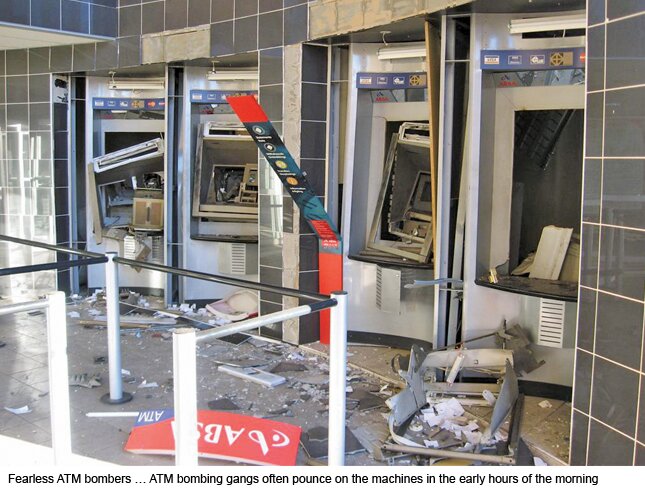
The rate of ATM bombings in the Free State has dropped by 26. 6 percent, following close collaborative efforts between the banking sector and the police
There has been a significant decline in the occurrence of automatic teller machines (ATM) bombings in South Africa in the past year, courtesy of joint efforts by local banks and law enforcement agencies.
According to the South African Banking Risk Information Centre (SABRIC), a national processing company assisting the banking and cash-in-transit industries to combat organised crime, ATM bombings dropped by 21 percent countrywide between 2011 and 2012.
Although SABRIC could not divulge the exact figures for ‘security reasons’, the police department disclosed that the number of cash-in-transit robberies dropped from 291 in 2011 to 182 in 2012, which represents 37 percent.
In an interview with The Weekly, the spokesperson of SABRIC, Bongani Diako, attributed the plunge in ATM robberies to counter-measures employed by the banks in collaboration with the police.
Diako could not delve into the details of the modus operandi, except to say the banking industry had also invested in public awareness and supported the law enforcement initiatives.
Heists are mostly predominant in Gauteng and portions of the provinces bordering Gauteng and the Western Cape. Police minister, Nathi Mthethwa, said recently that 83 cases of cash-in-transit attacks were registered in Gauteng during 2011 and 2012 followed by KwaZulu-Natal with 25 cases.
“The robberies result in significant financial losses for the banking industry, most importantly with respect to losses relating to the repair of infrastructure damaged as a result of bombings and the reinstallations of new ATMs. The cost of replacing a bombed ATM can be anything between R150 000 to R300 000, depending on the location of the said machine. What is particularly concerning is the violence accompanying these attacks and the loss of human lives,” said Diako.
Diako said ATM bombers predominantly target ATM’s that are located on sites that have been identified with the objective of providing convenience and easy access to banking services for the community.
“The banks and the law enforcement agencies will continue to embark on initiatives to create public awareness of different bank crimes, including ATM bombings where the public is encouraged to provide the police with information about perpetrators of this crime where it is available.
“We also commend the police for their role in the reduction of ATM bombings through their breakthrough arrests of some of the perpetrator groups and their prosecutions. The banking industry will continue its support and collaboration with the police because ultimately, the objective is to achieve a crime-free banking environment for all,” added Diako.
ATM raids are relatively few in the Free State. Last year in October the MEC for police roads and transport, Butana Komphela reported that the number of ATM bombings in the province fell from 15 in 2011 to 11 in 2012, marking a 26.6 percent drop.
Komphela said the department’s partnerships with stakeholders like SABRIC and Business Against Crime South Africa had helped reduce the crime. But on January 18, one of Absa’s ATM was hit with heavy explosives and an undisclosed amount of cash taken at about 00:40 in Rocklands, Mangaung.
SAPS spokeswoman, Lieutenant Colonel Thandi Mbambo, said the SAPS Organised Crime Unit is investigating a case of malicious damage to property and following leads after an ATM was bombed in the township.

It is alleged that about three unidentified males were in the ATM’s vicinity when it was bombed with the heavy explosives. Seconds after the explosion a red vehicle was seen speeding and now cops are urging anyone with information may contact the crime stop line on 08600 10111.
Meanwhile, a research made by University of South Africa’s (UNISA) security management expert, Sarika Sewpersad, shows that ATM bombing syndicates put much planning into their crimes.
“In planning the attack, a group chooses the location and for a period of time prior to the attack they will stake out the location and conduct pre-surveillance on the target. Syndicates take time to work out their escape routes, vehicles they will use during the job, what time they will carry out the attack and select a specific suitable day taking all factors such as busy times, traffic volumes, and other security measures present or not present,” said Sewpersad.
She said ATM bombing gangs spend a long time watching a target, checking to see when it is replenished, what time security guard patrols come past, what time the police patrol the area, and once they are satisfied that they will not be disturbed at a certain time and that on a specific day there will be a large amount of cash in the machine, they will set their day and time.
The study shows that the attacks will be carried out on the day when or a day after the ATM has been loaded to ensure a large amount of money. The evidence also specifies that dates are planned ahead can be confirmed from the analysis of media reports and case dockets.
The researcher found that from the total of the 100 SAPS dockets the most common day that an ATM bombing occurred was on a Thursday, with 21 incidents out of the 100 analysed occurring on this day.
Sewpersad revealed that the second most common day is Tuesday, with 18 incidents occurring on this day. Most incidents from the analysis of media reports took place on a Thursday, while ATM Solutions dockets reflected 54 percent of cases occurred on a Thursday.
“The days with the lowest number of ATM bombings occurred were Fridays and Sundays.
While there is no specific time that is chosen, the most common period for which ATM bombings occur is between midnight and 5:00,” added Sewpersad.
Sewpersad indicated that syndicate gangs may recruit a security guard, for an example, especially in isolated areas where there is no one else but a single security guard on duty to inform them once the police/security patrol vehicle has done its rounds.
“It has also been suggested that cash-in-transit personnel who load the ATMs may work in cahoots with these groups, informing them when the ATM is “full”. Alternatively, this forms part of their pre-surveillance.”
She explained that the leader or organiser of the operation informs each member of the group of their function in the team prior to the job to let them know of their role in the bombing session.
“While there is one or two members in charge of loading explosives into the ATM, others may be designated as drivers, in charge of holding guards hostage during the attack or patrolling the premises, armed and ready should they be confronted by the cops or a private security company armed response team,” Sewpersad concluded.

Ms. K Unrestricted


Follow Us onTwitter