
Mechanisation slowly taking shape
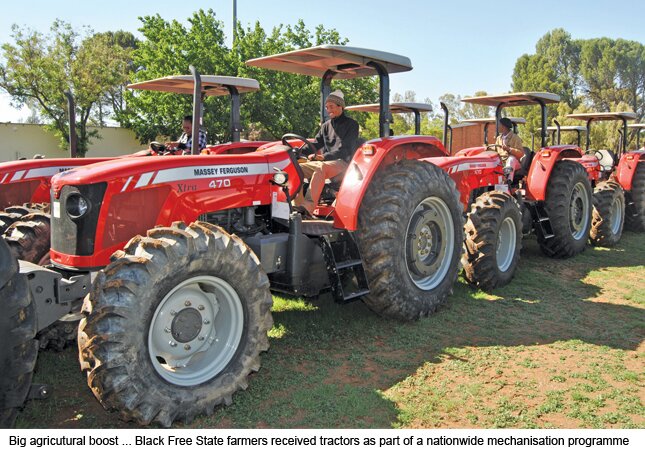
The Free State province, which has since allocated 72 tractors with supporting implements to community-based agricultural cooperatives
In a bid to give black farmers a realistic chance to improve production, increase yields and access domestic and global markets, the minister of agriculture, forestry and fisheries, Tina Joemat-Pettersson, announced plans in 2010 to launch an extensive, nationwide mechanisation programme.
This mechanisation support package was also envisaged to have a positive impact on economic development, job creation and food security in all provinces, including the Free State province, which has since allocated 72 tractors with supporting implements to community-based agricultural cooperatives.
Prior to this, the Free State department of agriculture and rural development had supported farmers with mechanisation needs through several initiatives, which saw 34 tractors being allocated to individual farmers in the 2005/2006 financial year when the province started its own mechanisation initiative.
The department’s spokesperson, Moliehi Tlhobelo confirmed that the department has a mechanisation policy and strategy aimed at extending support to emerging farmers, but could not delve into details regarding the programme’s success rate.
“The effectiveness of the initiative cannot be established currently, as the mechanisation support programmes – aimed mostly at small holder and subsistence farmers – are only being rolled out now,” she said.
“The small holder and subsistence sector lacks infrastructure, so the development of a mechanization programme can contribute significantly to better effective and efficient farming practices.”
Tlhobelo said purchasing of mechanical equipment via loans is not a viable solution as most farmers cannot afford it. Support thus has to be via grant funding.
She explained that the support is given by the department to farmers who are linked to the Farmer Settlement Support programmes, Commonage Development and Food Security programmes, mostly aimed at small holder and subsistence farmers.
“If more packages are procured the agricultural co-ops will be strengthened by adding more tractors and implements. The department has developed a plan that indicates how the support is going to be provided to farmers via co-ops” said Tlhobelo.
She went on to disclose that the department had facilitated the establishment of five co-ops (one per district), from which farmers can request support at established costs.
The mechanical equipment that has been distributed to farmers consists of 72 tractors and 350 implements in the form of trailers, ploughs, discs, planters, fertilizer spreaders and chemical sprayers.
One of the farmers who have applied for farming implements is Itumeleng Ditshoane, of Klein Krains farm in Bloemfontein, who confirmed that he knew a lot of farmers who had received farming equipment from the department of agriculture over the years.
He said being young has helped him as he has been classified in the youth category.
“This has been an advantage to me because there are very few young people who are interested in farming.”
“I top the list, so very soon I will be receiving the farming implements from the department and I will be able to contribute to the fight against hunger in the country,” he said optimistically.
The mechanisation initiative of the national government will allow Free State farmers to cultivate 7 200 ha of fields based on the assumption that five percent of all crop fields in the province (a total of 155 577 ha) is cultivated by small-scale farmers.
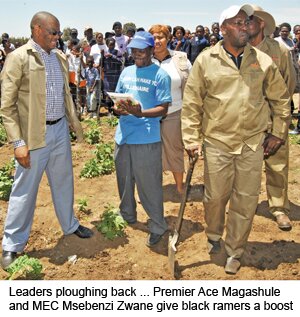 The Free State department of agriculture will allocate the mechanisation packages in a fair and transparent manner. Municipal areas in high potential crop production areas should receive bigger tractors and a wider variety of implements.
A multi-disciplinary technical committee will recommend options when rolling out the packages, which will be allocated to legal entities in the form cooperatives throughout the province.
A conservative figure for mechanisation requirements is that on average 1 kW of traction power will be required for each ha of land under cultivation. Under favourable circumstances one can assume a ratio of 0.5 kW for 1 ha under cultivation.
It is assumed that each tractor allocated to the province will be able to cultivate 100 ha with tractor sizes of 55 kW, 65 kW and 86 kW. Tractors will also perform other duties such as making firebreaks, transport with trailers and milling, and will thus not only be available for soil cultivation activities. Certain activities such as soil preparation and planting are seasonal activities.
There are five districts in the Free State with varying sizes of municipalities, populations and arable land.
Xhariep has more vacant land than the other four districts. According to studies done by the department, Xhariep consists of 3 424 966 hectors of land and the population size is 135 791. It has three local municipalities and 17 towns.
The district produces small stock, sunflower, vegetables, maize, vines, maize, wheat, potatoes, lucerne, ostrich and pecan nuts.
Motheo, which consists of the capital city, is the smallest region with only 1 399 864 hectors but the population size is 730 402. It has three local municipalities and 10 towns. It produces sheep, beef, maize and wheat and vegetables.
Lejweleputswa is 3 193 028 hectors big and has a population of 657 952. It is made up of five local municipalities that consist of 18 towns. The area produces maize, wheat, poultry, vegetables, game, groundnuts and sunflower.
Thabo Mofutsanyana is a 2 834 556 hector area that consists of 727 403 people who live in five local municipalities that consist of 19 towns. The area produces cattle, maize, wheat, flowers, asparagus, apples, cherries, peaches, vegetables, soya beans and potatoes Fezile Dabi is 2 130 046 hectors big with a population of 460 703 people in four local municipalities and 15 towns.
The area produces maize, wheat, sorghum, livestock, groundnuts, soya beans, potatoes and dry beans.

Ms. K Unrestricted


Follow Us onTwitter