
DEMYSTIFYING “HIV CURE” MYTH
 The discovery will help people who do not have the virus and not those already infected
While there have been numerous attempts over the years to develop a cure for HIV, the recent discovery of antibodies that are able to kill up to 88 percent of the AIDS virus types is not a cure.
The discovery, described as “ground-breaking,” provides a new approach that could be useful in making an AIDS vaccine, according to researchers.
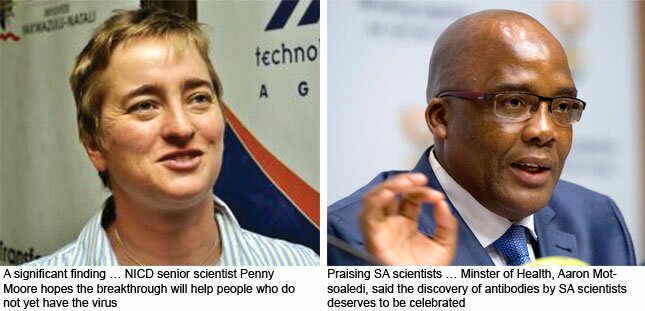
According to the National Institute for Communicable Diseases (NICD) senior scientist, Penny Moore, the broadly acting antibodies are only able to kill such a wide variety of infected cells.
However, the breakthrough has no direct benefit to HIV positive people because they already have the virus.
“We hope to help people who do not yet have the virus,” said Moore.
Moore said one of the strategies scientists are exploring is how to produce a vaccine that prompts the body to make “broadly acting antibodies” that combat multiple strains of HIV.
The research, performed by members of the Centre for the Aids Programme of Research in South Africa (Caprisa) consortium, comprising of scientists from the Wits University; the NICD in Johannesburg; the University of KwaZulu-Natal (UKZN) and the University of Cape Town (UCT). The scientists have been studying, for the last five years, how certain HIV-infected people develop very powerful antibody responses.
The study is based on blood samples taken at regular intervals over several years from two women infected with HIV, enabling scientists to study how both the virus and the women’s antibodies have changed over time.
One of the women was a sex worker from Durban while the other lived deep in rural KwaZulu-Natal (KZN), and both of them were HIV-positive. They were part of a rare group of people, about one-fifth, living with the disease whose bodies produce antibodies that work against a wide range of HIV strains.
According to Moore, when a person becomes infected with HIV, their body starts to produce antibodies to fight the virus but the virus gets there first.
As the virus changes with time, so do the antibodies.
“It’s always changing, always just one step ahead. They (antibodies) try to paint the virus into a corner, to get it to expose a vulnerability that will help them identify it,” explained Moore.
As the disease reaches an advanced stage, the virus coats itself with a sugar, called glycan, to protect itself against the constant onslaught of antibodies. The glycan is very important because host’s of antibodies adapt and recognise the sugar in such a way that they can kill nine of 10 known strains of HIV.
Glycan which is located at a specific point on the virus’s outer protein coating labelled 332 prompted the immune systems of these women to make antibodies that killed 88 percent of HIV strains.
Broadly neutralising antibodies can recognise it, target it and bind themselves to it. The result: the virus is blocked from infecting healthy cells in the body. This discovery provides new clues on how vaccines could be designed to elicit broadly neutralising antibodies.
This means a vaccine that targets just this glycan would be only partially effective, and suggests a vaccine would need to take aim at multiple weak points in the virus.
“Understanding this game of ‘cat and mouse’ between HIV and the immune response of the infected person has provided valuable insights into how neutralising antibodies arise,” added Moore.
While their existence has been known for a while, highly potent forms of broadly neutralising antibodies against HIV were only identified about three years ago. Until now, it was not known how the human body is able to make broadly neutralising antibodies.
This study discovered one mechanism by which these antibodies may be made. To make this discovery, the research team studied the target of some of these antibodies, a sugar that coats the surface protein of HIV, forming a site of vulnerability. By tracing back the evolution of the virus that elicited these antibodies, this team showed that this particular weak point was absent from the virus that first infected these women.
However, under constant pressure from other less powerful antibodies that develop in all infected people, their HIV was forced to expose this vulnerability over time. This allowed the broadly neutralising antibodies to develop.
Analysis of a large number of other viruses from around the world, performed in collaboration with scientists from the University of North Carolina and Harvard University, suggest that the vulnerability at position 332 may be present at the time of infection in about two thirds of subtype C viruses (the subtype most common in Africa). Hence, if a vaccine is developed to target this glycan only, it may not be able to uniformly neutralise all subtype C viruses; as a result AIDS vaccines may need to attack multiple targets on the virus.
This research was funded by the South African government’s department of science and technology; the US national institutes for health (through the NIAID-funded Centre for HIV/AIDS Vaccine Immunology) and the Bill and Melinda Gates Foundation (through its Collaboration for AIDS Vaccine Discovery).
The long-term follow-up studies of the women in KZN were additionally funded by the South African Technology Innovation Agency as well as USAID (through CONRAD) and CDC as part of PEPfAR. Fellowships from the Fogarty International Centre and the Wellcome Trust played a key role in enabling this research.
The South African health minister, Aaron Motsoaledi, said the discovery of antibodies that could neutralise and kill the HIV by SA scientists deserves to be celebrated.
“This is a great day in SA. Our researchers and scientists have done us proud once again. Our scientists have also in the past helped us understand the mother-to-child transmission of the virus. Their ground-breaking work brings us closer to developing an HIV vaccine,” Motsoaledi said.
The government was a co-funder of the study. Other funders included the US National Institutes of Health and the Bill and Melinda Gates Foundation. Motsoaledi thanked the two women living with the virus who volunteered to be part of the research.
“Participants in research projects are never thanked enough. I thank the two women for being part of this… they are also scientists in one way or another.”
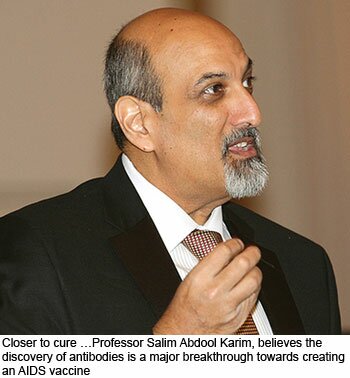
Commenting on the significance of the finding, Professor Salim Abdool Karim, who is the director of Caprisa and president of South Africa’s Medical Research Council, said that broadly neutralising antibodies were considered to be the key to making an Aids vaccine.
“This discovery provides new clues on how vaccines could be designed to elicit broadly neutralising antibodies,” said Karim.
HIV/AIDS FACTS
Ever since it was discovered in the early 1980s, HIV/AIDS has killed more than 28 million people worldwide, with over 34 million currently living with the virus infection.
Last year Statistics South Africa estimated that around 5.4 million people in the country were infected with the HI virus.
There are two types of HIV: HIV-1 and HIV-2. Both these types are transmitted by sexual contact; through blood or from mother to child and they appear to cause clinically indistinguishable AIDS.
However, it seems that HIV-2 is less easily transmitted, and the period between initial infection and illness is longer in the case of HIV-2.
Worldwide, the predominant virus is HIV-1, and generally when people refer to HIV without specifying the type of virus they will be referring to HIV-1. The relatively uncommon HIV-2 type is concentrated in West Africa and is rarely found elsewhere.
The strains of HIV-1 can be classified into four groups: the “major” group M, the “outlier” group O and two new groups, N and P. These four groups may represent four separate introductions of simian immunodeficiency virus into humans.

Ms. K Unrestricted


Follow Us onTwitter