
INITIATION DEATHS ADDRESSED
The health department is seeking to enforce strict guidelines which include providing pit latrines, toilet paper, enough blankets and adequate for initiates
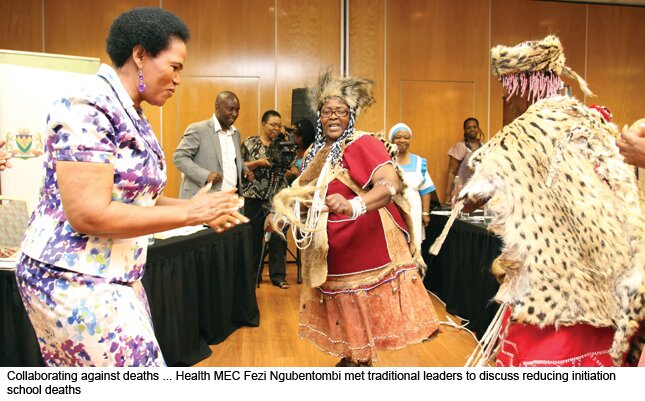
As the season of cultural circumcision nears, the department of health in the Free State met with stakeholders during a workshop in Bloemfontein yesterday to devise means to prevent unnecessary deaths at initiation schools in the province.
The workshop brought together traditional leaders, police and members of the National Prosecuting Authority (NPA), who discussed challenges and came up with recommendations on how to reduce the death of initiates.
It is a common occurrence every year that during this season, boys are taken to a secluded location to go through a rite of passage into manhood. This ritual practice includes circumcision.
However due to non-adherence to accepted cultural procedures and required health practices, hundreds of young boys have died at the initiation schools, in the past, throughout the country and the Free State is no exception.
“This is a big challenge that has to be dealt with because if it is not tackled effectively it will continue be a threat to the lives of young men. This practice has been turned into a business venture by greedy individuals. This is the reason we feel that traditional leaders had to step up and deal with this,” said Chief Pienaar Molefe.
Molefe said it was important for traditional leaders to protect the initiation practise from people who want to abuse it for personal gain.
“We love our culture and we want to protect it from those who want to misuse it. According to our culture, a person who wants to initiate boys must have his own son who has gone through the ritual. You cannot take other people’s children and say you will circumcise them; you need to start with your own child. This is a once off thing; it is not a business.”
He said the initiation school instructors must adhere to the precautionary measures and guidelines, as outlined by the department of health.
According to Molefe, being a traditional healer does not necessarily qualify one to practise initiation. He said the death of initiates raises legal and ethical dilemmas for the practice.
“In the event of an initiate dying, then a school becomes a crime scene and police need to gather evidence. This is something that turns out to be an uphill battle because traditions do not allow people to divulge what happens at initiation schools.
“There are a lot of deaths in these initiation schools, especially in QwaQwa. However, it is not always easy to get a witness to testify because they are afraid to come forward. The challenge here is that their tradition does not allow them to disclose what happened inside the schools,” added Molefe.
When approached by The Weekly for comment, the NPA regional chief prosecutor, Sello Mahloko, was adamant that the law has to be upheld, regardless of circumstances.
“People need to understand that they cannot commit crimes and hide behind traditional practices. If someone dies, they need to tell us exactly what happened.”
The provincial department of health has set-up a committee that monitors initiation schools in the province. This year, two illegal schools were destroyed in Botshabelo, after six boys died from hunger and unhygienic conditions. They were aged between 15 and 23 years.
During the demolition of these schools, the initiation committee found out that the school was illegal because the children did not have permission from parents and were not checked by a medical doctor as required by the law.
The chairperson of the Botshabelo Initiation Committee, Ralihlare Molete outlined the conditions for a child to be admitted at an initiation school.
“If a parent brings their child to the school, they must first submit an affidavit at a local police station, and copies of the identity documents of both the parent and the child. A letter from a clinic must also be obtained. The same applies to the owner of the initiation school who is supposed to be an adult over the age of 40.”
Molete said it is imperative to have enough food supplies and a hygienic environment to conduct an initiation school. Children pay R1 500 each for the food and other basic necessities that should be provided during initiation. The prices differ from one school to another.
The department of health has recommended several precautionary measures to safeguard the health and welfare of initiates.
In order to provide adequate sanitation, pit latrines, toilet paper and soap, for hand washing, must be provided for the duration of the initiation. Clean water must be available at all times for the purpose of drinking and washing. A clean water tank or clean plastic containers in which to store the water must be provided;
A sink or brick structure for the preparation of food can be erected and must have a door; cement floor and windows which can open, as well as tables on which the food can be prepared. Only food which is fit for human consumption must be provided to persons at the school.
Persons undergoing initiation must be provided with enough blankets, especially during winter months, to avoid deaths that may be caused by freezing.
“We do not want the repetition where young boys die at the initiation schools. We are really concern about the unnecessary death and we are trying by all means to address it. We need the participation of everyone concerned,” said the health department’s acting spokesperson, Tebogo Oepeng.

Ms. K Unrestricted


Follow Us onTwitter